Perhaps that is what makes the present moment so interesting. We have become exceptionally good at recognising what authenticity looks like. We know the colours. We know the textures. We know the photographs, the typography, the imperfections, the old paper, the handwritten notes and the carefully placed traces of another time. We know how to make something feel as though it has lived before us. And once we learned the language, we learned how to reproduce it. Rust can be printed. Imperfection can be designed. Nostalgia can be packaged. A photograph can be made to feel like memory. A typeface can suggest generations. A new object can be dressed in the visual language of an old one before it has had the chance to acquire a history of its own. This is not an argument against aesthetics. Aesthetics matter. Beauty matters. The way we choose to present something can carry emotion, memory and meaning. A photograph can preserve a moment. A drawing can carry someone’s hand across generations. A postcard can become a little piece of a place, even when it travels far beyond that place. Its value does not come from looking old. It comes from what it carries. The problem begins somewhere else. It begins when we borrow the appearance of authenticity without building the substance that gives that appearance meaning.
THE IMITATION GAME
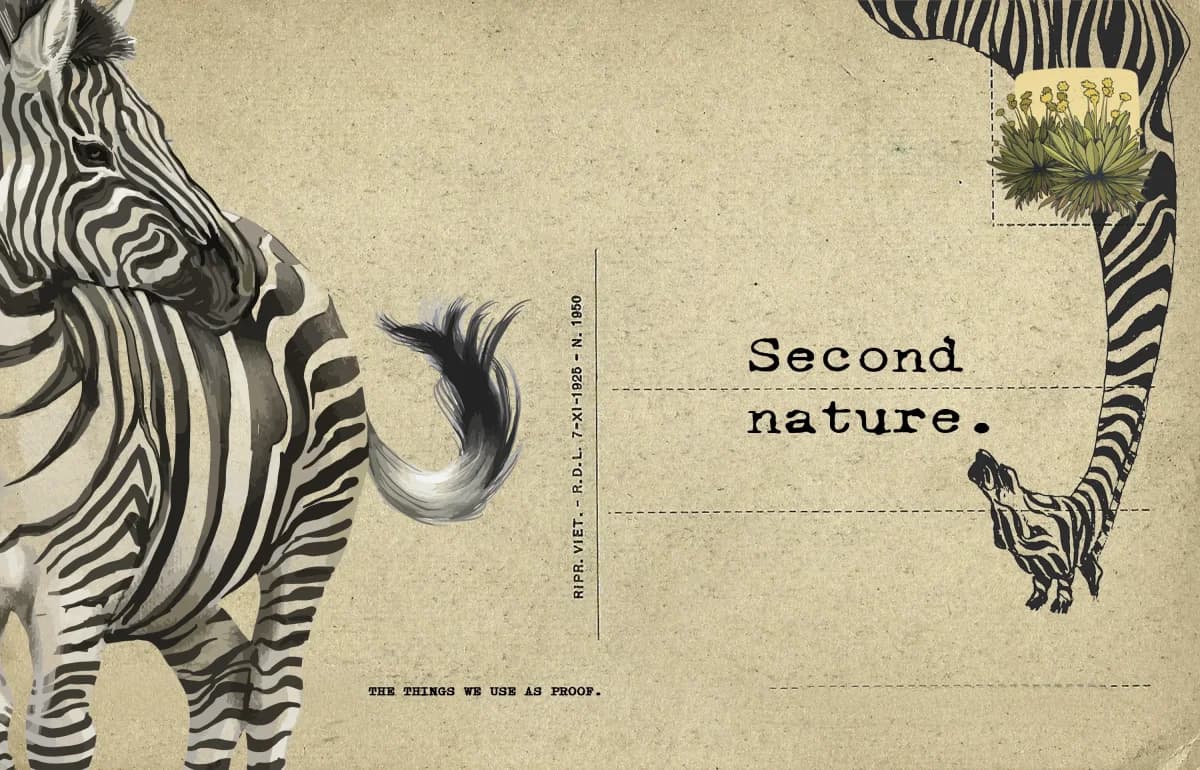
There is nothing inherently wrong with a beautiful package, a carefully composed photograph, an old-fashioned typeface or a postcard. In fact, some of these things can be deeply personal. A postcard can be a record of somewhere we have been. It can carry an original work of art. It can be a message from one person to another. It can hold a memory that existed before the object itself. Its value does not come from looking old. It comes from what it carries. That distinction matters. At Kaapilibre, our visual language has deliberately taken the form of the postcard. Even our thank-you notes carry something of home. Painted by our mother — the woman who raised us, the two brothers behind Kaapilibre. She made them long before there was a brand to make them for. We never asked for something that looked authentic. We simply shared something that was already hers. And somehow, ours too. Some things don't need to look real. They come from somewhere real. It is a medium through which we can carry something personal forward. The difference may seem small. It is not. There is a difference between using an aesthetic because it belongs to you and using an aesthetic because you have learned that it makes something appear authentic. One comes from authorship. The other comes from imitation. And perhaps we have become so accustomed to the second that we no longer notice the difference. We see a weathered photograph and assume history. We see rough paper and assume craft. We see a handwritten font and assume human touch. We see a remote landscape and assume purity. We see the photograph of a farmer and assume connection. But these are only signs. They may point towards something real. They may also point towards nothing at all. The more recognisable the signs become, the easier they are to reproduce. Recent research into independent coffee shops has observed precisely this tension: spaces built around ideas of individuality, locality and authenticity can gradually converge around the same visual vocabulary. What begins as an expression of identity can become a template for appearing distinctive. That is perhaps the strange thing about aesthetics. The moment a particular look becomes shorthand for authenticity, authenticity becomes easier to imitate.
THE STORY BEHIND THE STORY
This becomes more complicated when we look at specialty coffee. Coffee has always carried stories. It has travelled through landscapes, families, cultures and generations long before we began printing those stories on bags. But specialty coffee has given us an extraordinary vocabulary for describing them. We speak of origin, varietal, altitude, processing, fermentation, terroir, traceability and scores. We have become much better at telling people where a coffee came from and why it tastes the way it does. That is a beautiful development. Knowing more about a coffee can deepen our appreciation of it. Traceability can create genuine connection. Origin can matter. A farmer’s knowledge can matter. The landscape can matter. The way a coffee is grown and processed can matter. But knowing the language of authenticity does not automatically make the relationship authentic. A coffee can carry the name of a farm, the photograph of a farmer and a beautifully written account of its origin, and all of these things may be completely true. Yet a true story can still be an incomplete story. We can know the altitude without knowing who carried the risk of growing the crop. We can know the varietal without knowing whose knowledge preserved it. We can know the processing method without knowing who invested the labour required to make it possible. We can know the farmer’s name without knowing what their participation in the value of that coffee actually looks like. This is where traceability becomes an interesting word. We have become increasingly skilled at tracing coffee backwards. Perhaps we should become equally interested in tracing value backwards. Because origin tells us where something began. It does not necessarily tell us what happened to it along the way.
THE FARMER IN THE STORY
For a long time, the farmer was almost invisible in the journey between farm and cup. Today, we want to know their names. We want to see their faces. We want to understand their farms, their methods and their landscapes. That visibility is important. But visibility can become its own kind of aesthetic. A farmer can become everywhere in the story and nowhere in the value. Their face can become authenticity. Their land can become atmosphere. Their harvest can become a selling point. Their history can become part of a brand identity. The story may be completely true. And yet the relationship behind the story may still be incomplete. Writing on the fetishisation of coffee farmers has questioned the distance between producer imagery and the economic realities of coffee production, while more recent discussion of “farmwashing” has raised concerns about situations where farmer stories create commercial value without necessarily representing the depth of the sourcing relationship behind them. This is not an argument against telling the farmer’s story. It is an argument for telling it honestly enough that the photograph is not the most important part of the relationship. If we celebrate someone’s knowledge, we should value that knowledge. If we celebrate the place they cultivate, we should care about what happens to that place. If we tell people that a coffee is exceptional because of the work, land and knowledge behind it, then perhaps the people responsible for those things should not disappear from the conversation as soon as the coffee leaves the farm. A name printed on a bag can tell us who grew the coffee. It cannot, by itself, tell us what that person means to the relationship. Visibility is not participation. A photograph is not a relationship. Traceability, however valuable, is not the same thing as connection.
THE ORIGIN WE CHOOSE TO SEE
We have also become very good at romanticising origin. We love the mountains, the mist, the forest, the old trees, the distant village and the morning light falling across a coffee plantation. We love unusual varietals and forgotten methods. We love the idea of discovering something hidden, something untouched, something that seems to have survived outside the ordinary rhythms of the modern world. We turn places into stories. Then we turn those stories into identities. But an origin is not a backdrop. A place is not simply a beautiful landscape behind a product. It is weather and soil and memory, but it is also labour and uncertainty and economics. It is the knowledge passed from one generation to another and the risks carried by the people who depend upon the next harvest. It is what happens when the rains arrive too early, when prices fall, when a crop fails, when a disease appears, when a family has to make a decision that will never make it into the final story. These things are not particularly aesthetic. That may be precisely why they are so often left outside the frame. The question becomes even more interesting in India, where specialty coffee has sometimes adopted visual and cultural cues developed elsewhere. The Specialty Coffee Association’s discussion of Indian coffee examines this tension between imported specialty-coffee frameworks and the histories, identities and realities of Indian coffee itself. A place can be made visible and still be seen through someone else’s eyes. Real places are rarely that simple. Real people are rarely symbols. And perhaps authenticity begins precisely where the convenient story ends.
THE THINGS WE USE AS PROOF
Consider how quickly we have learned to associate certain things with truth. Recycled paper feels responsible. A handwritten typeface feels human. A weathered photograph feels historical. A remote origin feels pure. A farmer’s portrait feels connected. A rustic package feels artisanal. A story filled with heritage feels trustworthy. But these things are signals, not guarantees. A beautiful package cannot prove a meaningful relationship. A photograph cannot prove fair participation. A word cannot prove a practice. A landscape cannot prove stewardship. A story cannot prove that the system behind it deserves the story being told. The more sophisticated our visual language becomes, the easier it becomes to mistake the language for the reality. That is the paradox. We have become better at communicating authenticity at exactly the same time that authenticity has become easier to imitate. Perhaps this is why we should not become cynical about aesthetics. We should simply become curious about them. Where did this language come from? Why does it make us feel what it makes us feel? And more importantly, what is it actually telling us? A beautiful story may be true. But what exists beyond the story?
WHEN THE AESTHETIC IS REMOVED
Perhaps the simplest test is to remove the aesthetic. Not because aesthetics are false, but because they should never have to carry the burden of proving what they did not create. Take away the photograph. Take away the typography. Take away the paper, the colour, the composition and the carefully chosen words. Then ask what remains. If the relationship remains, perhaps there is something real. If the respect remains, perhaps there is something real. If the farmer still matters when there is no photograph to publish, perhaps there is something real. If the origin still matters when it is no longer useful as a selling point, perhaps there is something real. If the claim survives without the packaging, perhaps the claim was never dependent on the packaging in the first place. This is not about making everything ugly in the name of honesty. Nor is it about rejecting romance. Romance has always been part of the way human beings understand the things they love. It is about remembering that beauty should be the expression of something meaningful, not the substitute for it. There is a difference between making something beautiful and making beauty responsible for proving that something is true. The first is design. The second is disguise.
LET THE TRUTH HAVE ITS OWN TEXTURE
Perhaps we should stop trying to make authenticity look authentic. Let a farm be beautiful because it is beautiful, not because we have learned that beautiful farms sell better. Let a coffee be artisanal because someone has spent years learning how to grow, process or roast it, not because the packaging knows how to imitate another century. Let a postcard be a postcard because it carries something worth sending, not simply because postcards have acquired the appearance of another time. Let a relationship be meaningful because people have invested in one another, not because we have written the right words about it. Do not make the coffee look connected to its origin. Build a relationship with the people and places behind it that makes the connection true. Do not make the farmer look important. Make their knowledge, work and participation important. Do not make sustainability look beautiful. Build practices that remain responsible when there is no camera pointed at them. Do not manufacture the appearance of craftsmanship. Build something carefully enough that craftsmanship becomes unavoidable. Perhaps this is what we have forgotten in our fascination with presentation: the strongest things rarely need to perform what they are. A well-made thing does not have to constantly announce that it is well made. A meaningful relationship does not need to be photographed every time it exists. A place does not become important because we have learned how to describe it beautifully. And authenticity does not become real because we have learned how to make it recognisable. It becomes real because it exists when nobody is looking.
WHAT IS LEFT
Maybe that is the question worth carrying with us. Not: Does it look authentic? But: What makes it true? Who made it? Who grew it? Who carried the risk? Who created the value? Who participated in the relationship? What happened outside the photograph? What remains when the story is no longer being told? Because authenticity is not a colour palette. It is not a paper stock, a photograph, a font or a carefully chosen adjective. It is not something that can be printed on the front of a package and considered finished. It is what remains after all of those things are removed. We do not need to abandon beauty. We simply need to stop asking beauty to prove what only truth can prove. Perhaps the old world never needed an aesthetic. Perhaps we invented one because we had forgotten that a thing does not become more genuine by looking the part. It becomes genuine by being what it claims to be. And maybe that is the responsibility of anyone who chooses to tell the story of a place, a person, a craft, or a coffee. Not to make authenticity look convincing. But to build something that does not need convincing. DON’T DESIGN AUTHENTICITY. LIVE UP TO IT. STAND BY THE TRUTH. BUILD WHAT MAKES IT WORTHWHILE.
FURTHER READING
Julia Smith, Coffee Landscapes: Specialty Coffee, Terroir, and Traceability in Costa Rica (2018); The Fetishisation of Coffee Farmers, Coffee Intelligence (2022); What is “farmwashing” in specialty coffee?, Coffee Intelligence (2024); Kelly Gregg, Jeffrey Nathaniel Parker, Conrad Kickert & Ian Trivers, Culture, Consumption, and the Aesthetic Homogenization of Independent Coffee Shops in the United States and Canada (2026); Namisha Parthasarathy, Jaago and Smell the Coffee: Deanonymizing (and Decolonizing) Indian Coffee, Specialty Coffee Association.